
Vodafone
PAYG to PAYM Migration
Role:
Lead UX Designer
Year:
2024/2025
Methods:
UX Strategy · Journey Mapping · Usability Testing · Stakeholder Alignment
Summary
Vodafone's PAYG customers had no digital route to upgrade to Pay Monthly; migration was only possible through assisted channels, creating friction and missed conversion opportunities. I led the end-to-end UX strategy to design a fully digital migration journey, balancing eligibility verification, trust-building, and plan clarity across two distinct user entry points.
End-to-end digital journey delivered
Designed for both known and unknown users, reducing drop-off risk and enabling Vodafone to migrate PAYG customers to contract plans at scale, without assisted channel dependency.
Key impact
Journey concepts designed & validated
Cross-functional stakeholder sessions
Moderated user research sessions
PROJECT OVERVIEW
Vodafone's PAYG-to-PAYM migration journey had no digital route; customers could only upgrade through assisted channels, creating friction, delays, and missed commercial opportunities.
I led the end-to-end UX strategy to design a fully digital, self-serve migration experience, enabling PAYG customers to upgrade to Pay Monthly SIMO plans whenever and wherever they chose.
The project required balancing eligibility verification, trust, and clarity across two distinct entry points (targeted SMS campaigns and open web) while aligning a complex cross-functional team across product, marketing, engineering, legal, and compliance.
Context
BUSINESS OBJECTIVES
Enable a fully digital, scalable route for PAYG → PAYM migration, removing dependency on assisted channels
Support contextual, behaviour-based marketing triggers (e.g. top-up patterns, high data usage, device change) to reach the right customers at the right moment
Reduce operational overhead by shifting migration volume from call centres and retail to self-serve digital
Create a foundation for future personalisation and optimisation across migration entry points
UX CHALLENGE
Designing for two distinct user types: known customers arriving via targeted SMS, and unknown users discovering the offer through search or web navigation
Verifying eligibility without adding friction, users needed confidence the offer was genuine and exclusive to them, without unnecessary gates
Managing scepticism and trust around switching from a flexible PAYG model to a monthly commitment
Clearly explaining the differences between PAYG and PAYM at the right moments, without overwhelming or slowing the journey
MY ROLE
Defining the overall UX strategy for PAYG → PAYM migration
Designing and comparing alternative journey approaches to identify the most effective structure
Leading and synthesising moderated qualitative user research
Translating research insights into clear design principles and recommendations
Aligning UX decisions with business, marketing, technical, and regulatory constraints across multiple stakeholder groups

Define
PROBLEM STATEMENT
Vodafone had no digital route for PAYG customers to migrate to Pay Monthly; the only available path was through assisted channels (call centres, retail), introducing delays, friction, and lost conversion
The absence of a self-serve journey created uncertainty around eligibility, offer exclusivity, and what the commitment actually meant
The challenge was to enable conversion in a way that felt clear, credible, and customer-first, without alienating users unsure whether the offer applied to them
HYPOTHESES
Early, lightweight eligibility confirmation (e.g. phone number verification) will increase user confidence without being perceived as friction
Explaining PAYG vs PAYM differences at key decision points will reduce uncertainty and support commitment to the switch
An experience that feels exclusive and personally relevant will make customers feel valued and more motivated to migrate
DESIGN-LED CHALLENGE
From a UX perspective, the challenge was to design a migration experience that:
Works for two fundamentally different user types, known customers arriving via targeted SMS, and unknown users discovering the offer through search or web
Makes eligibility verification feel reassuring, not intrusive, reinforcing that the offer is genuine and exclusive
Explains the PAYG vs PAYM difference at exactly the right moment in the journey, not too early to overwhelm, not too late to lose confidence
Enables customers to register, migrate, and confirm their plan in one seamless flow, without unnecessary steps or redirects
Design
Experience Strategy

1.
Eligibility first, friction never
Customers needed confidence that the offer was genuine and relevant to them, eligibility verification had to feel like reassurance, not a gate.
2.
Clarity at the moment of commitment
The difference between PAYG and PAYM was explained at key decision points only, not upfront to overwhelm, not too late to create doubt.
3.
One journey, two entry points
A single, scalable design had to work for both known users (via SMS) and unknown users (via web), without splitting into two separate flows.
Journey Exploration - Two Concepts
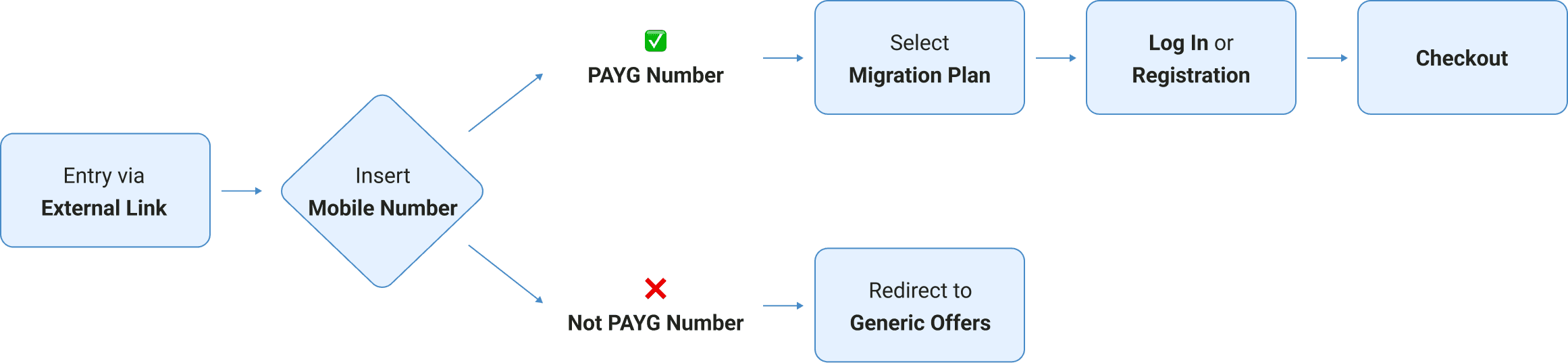
Journey Option A
Early Eligibility Verification
Key characteristics
Clear eligibility confirmation before seeing plans
Immediate reassurance that the deal was genuine and exclusive
Lightweight verification step, phone number only
Risks identified
Potential perception of unnecessary friction, especially for users arriving via SMS who had already been pre-selected
Questions around why verification was required after receiving a targeted message
USER JOURNEY
MOCKUPS
PROTOTYPE
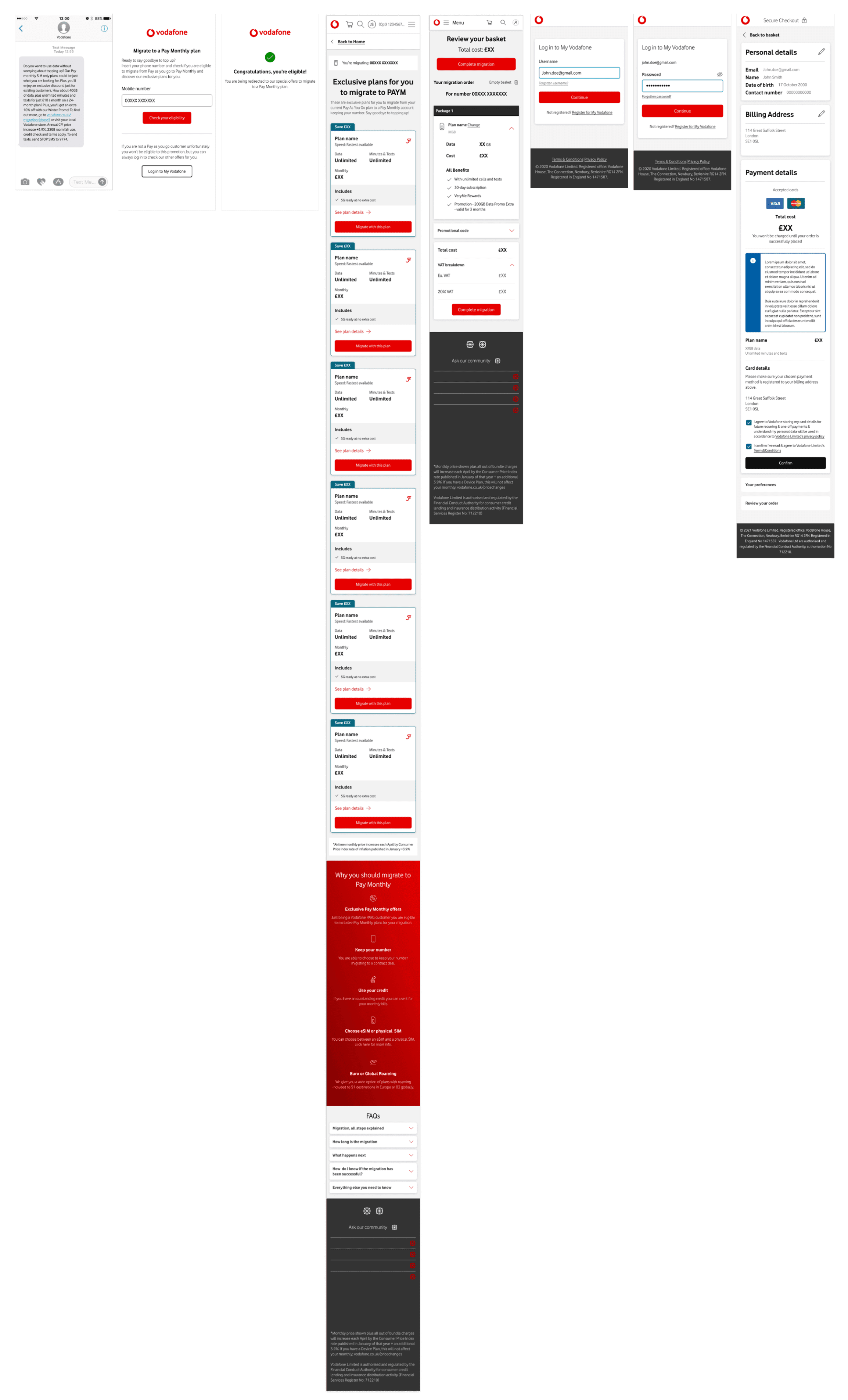
Early eligibility in action
The prototype demonstrates the full Option A journey, from phone number verification at entry, through plan selection, to migration confirmation.
Designed to test whether upfront eligibility reassurance increased user confidence and reduced hesitation at the point of commitment.
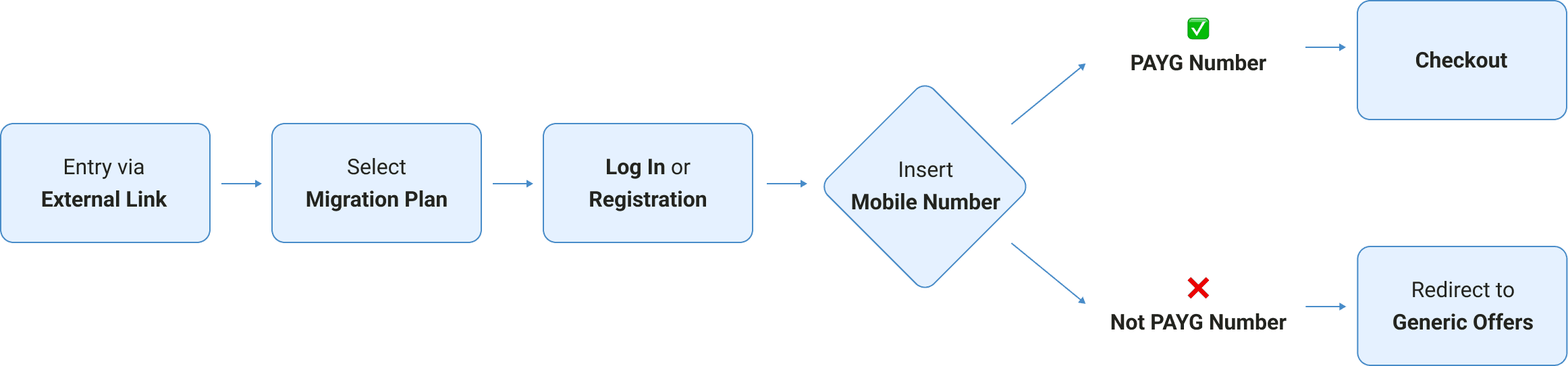
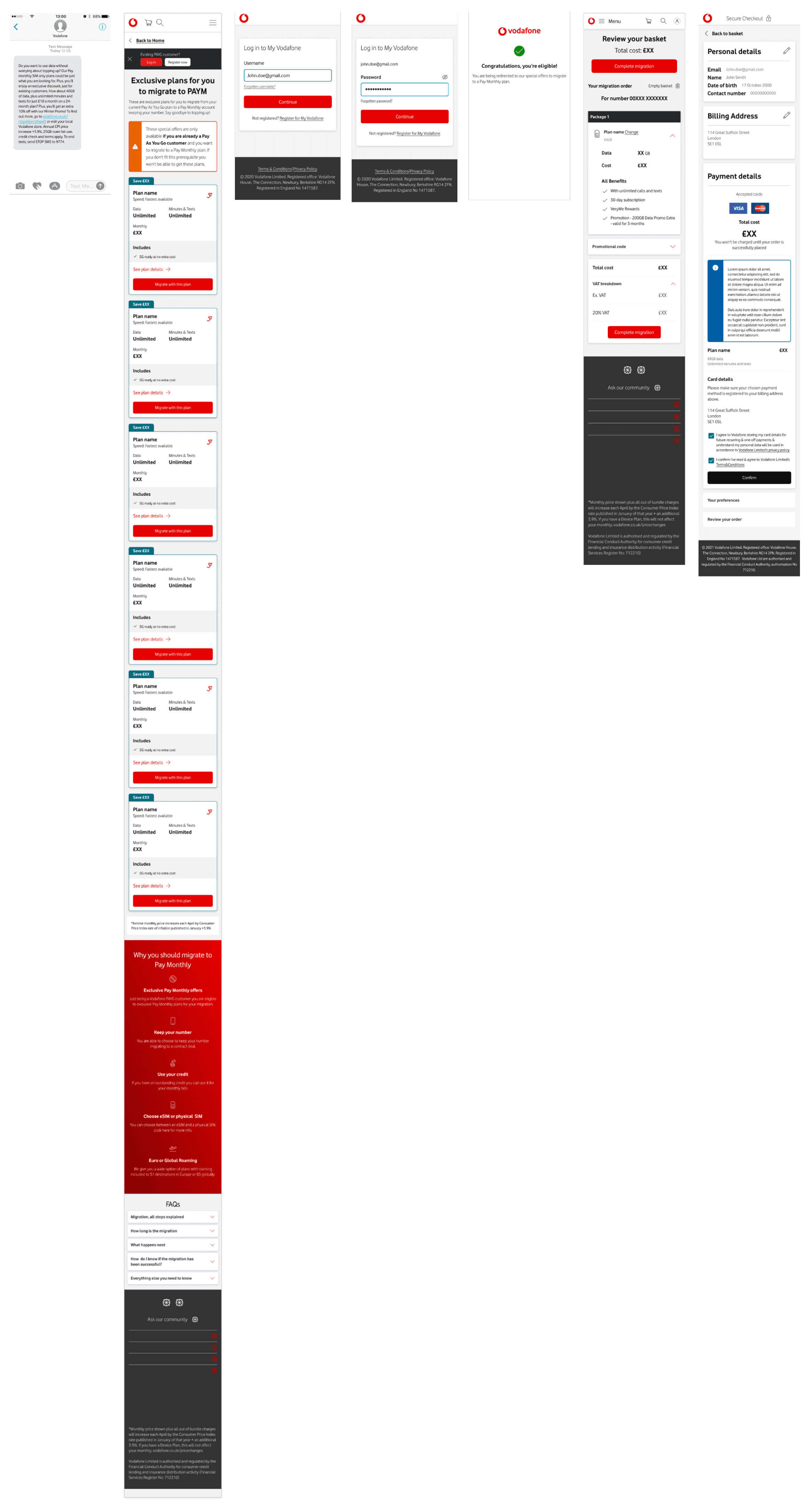
Journey Option B
Implicit Eligibility with Login Prompt
Key characteristics
Lower entry barrier, users reached offers immediately
Login used as a trust and security mechanism later in the flow
Relied on customers' existing awareness of being PAYG
Risks identified
Without early verification, some users may question whether the offer truly applied to them
Login prompt later in the journey risked feeling interruptive at a critical decision moment
USER JOURNEY
MOCKUPS
PROTOTYPE
Implicit eligibility in action
The prototype demonstrates the full Option B journey, from direct offer access, through plan selection, to login-prompted verification and migration confirmation.
Designed to test whether removing the upfront eligibility gate reduced friction and maintained user trust without early verification.
Validate
User Testing
Research Setup
4 PAYG customers actively considering switching to Pay Monthly within 12 months
Method
Moderated sessions, 45–60 minutes
Participants imagined receiving a real SMS offer from Vodafone
Each participant completed both journeys.
Identify friction points, trust signals, and understanding of the migration concept

Eligibility awareness
FINDING
All participants were confident they were PAYG customers. Crucially, the upfront phone number check in Option A was not perceived as friction, it was seen as reassuring and purposeful.
DECISION
Retain early eligibility verification as the foundation of the final journey. Frame it as confirmation, not a gate.
Login later in the journey
FINDING
Participants accepted the phone number verification as simple and quick. When login appeared later in the flow, it reinforced security and trust rather than feeling interruptive.
DECISION
Keep login as a mid-journey trust signal, not an entry barrier. Position it as protecting the user, not blocking them.
Offer exclusivity
FINDING
Participants perceived the offers as "special" but not fully personalised. Without a visible eligibility step, the sense of exclusivity weakened, users questioned whether the deal was genuinely for them.
DECISION
Make eligibility confirmation visible and explicit early in the journey to reinforce the perception that the offer is genuine, exclusive, and relevant.
PAYG vs PAYM clarity
FINDING
Participants could compare PAYG and PAYM confidently when differences were shown at the right moment. Showing this information too early created noise; too late created doubt
DECISION
Introduce PAYG vs PAYM comparison at the plan selection step only, not on entry, not at checkout.
Hypothesis Outcome
All three hypotheses were validated through research:
Early, lightweight eligibility confirmation increased confidence without adding friction
Explaining PAYG vs PAYM at key decision points reduced uncertainty and supported commitment
A journey that felt exclusive and personally relevant motivated users to proceed
Impact
Final journey
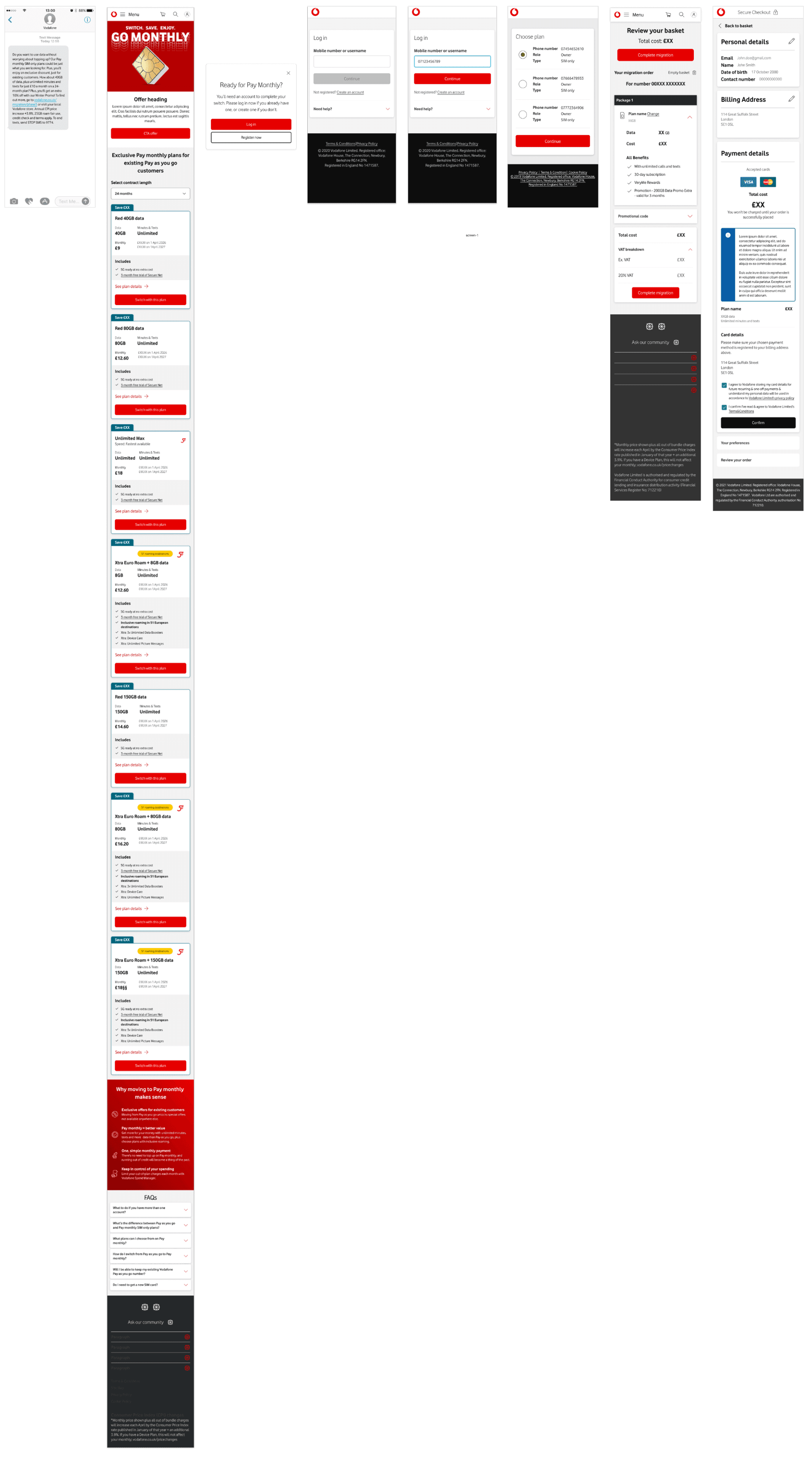
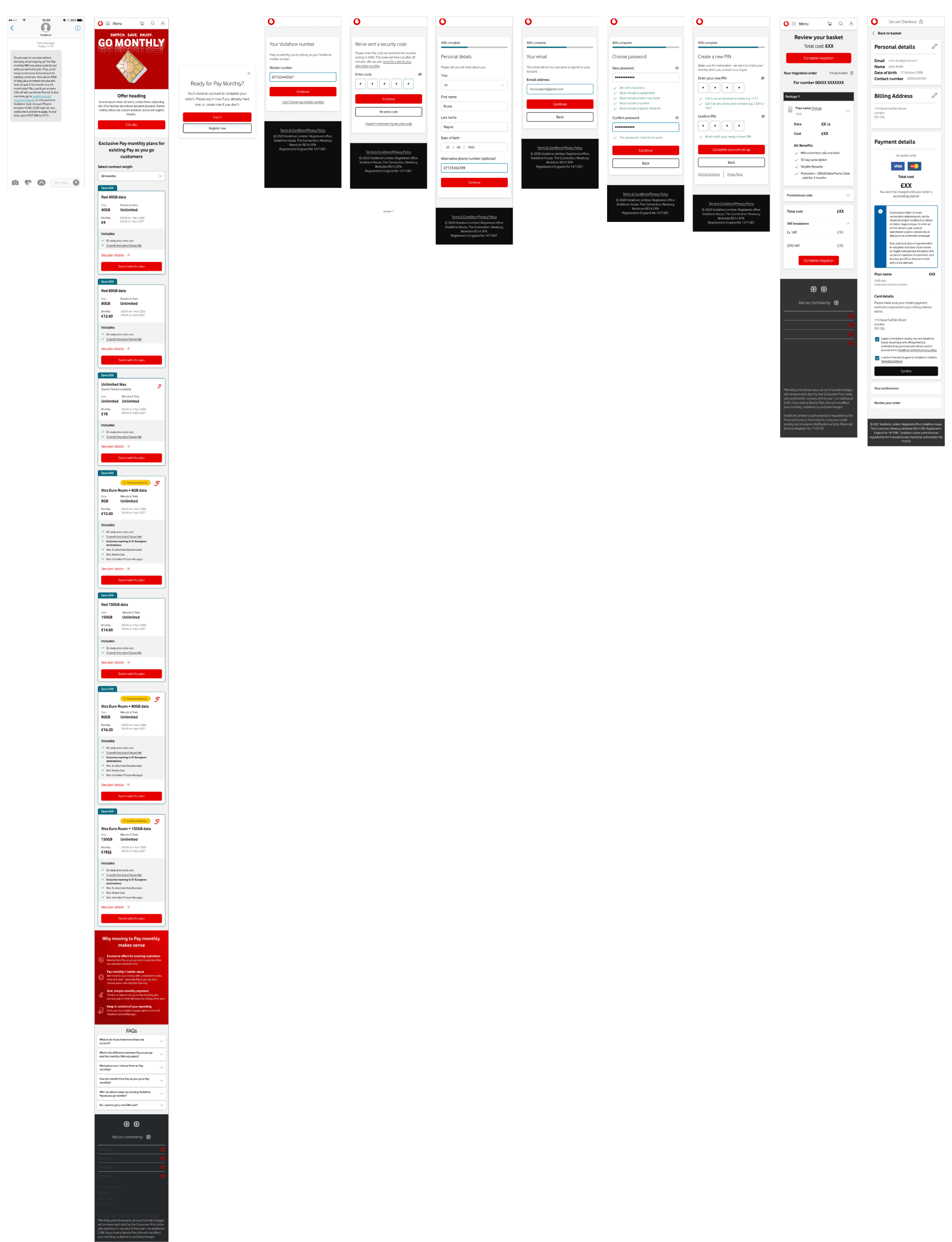
Following research validation, the two concepts were consolidated into a single, scalable journey. The final design adopted Option A's early eligibility verification as the structural foundation, combined with Option B's lighter entry tone, removing unnecessary gates while maintaining the trust signals users needed to commit.
The journey accommodates two distinct entry points:
Registered / Logged-in users
Verified immediately via account details, progressing directly to migration offers with no additional steps
Non-registered / Not logged-in users
Prompted to verify via phone number, then guided through a lightweight registration before accessing plans
REGISTERED / LOGGED-IN USERS
NON-REGISTERED / NOT LOGGED-IN USERS
REGISTERED USERS
NON-REGISTERED USERS
PROTOTYPE
Migration in action
The prototype demonstrates the complete end-to-end migration journey across both user states, registered customers progressing directly to offers via account verification, and non-registered users guided through a lightweight eligibility check before accessing plans.
Designed to validate that a single, scalable journey could serve two fundamentally different entry points without splitting into separate flows or creating dead ends.
Hypothesis Proven
Early eligibility verification, clear PAYG vs PAYM communication, and a sense of genuine exclusivity (all three hypotheses validated through moderated research) were embedded into the final journey design, delivering a scalable, confidence-led migration experience ready for implementation.
Conclusion
What was delivered
A fully digital, end-to-end PAYG → PAYM migration journey; designed for both known and unknown users, validated through moderated research, and aligned across 8+ cross-functional teams including Product, Marketing, Engineering, Legal, and Compliance.
Impact
The final design removed Vodafone's dependency on assisted channels for PAYG migration, established a scalable digital foundation for future personalisation, and delivered validated design principles (eligibility clarity, trust-led verification, and contextual plan comparison) that directly reduced drop-off risk and increased user confidence at the point of commitment.
What I'd do differently
With more time, I would have simplified the information architecture earlier in the process, some complexity in the journey stemmed from trying to accommodate too many edge cases at once.
I'd also push for a larger and more diverse research sample, particularly to stress-test the non-registered user path, which carried the highest drop-off risk and received the least validation coverage in this round